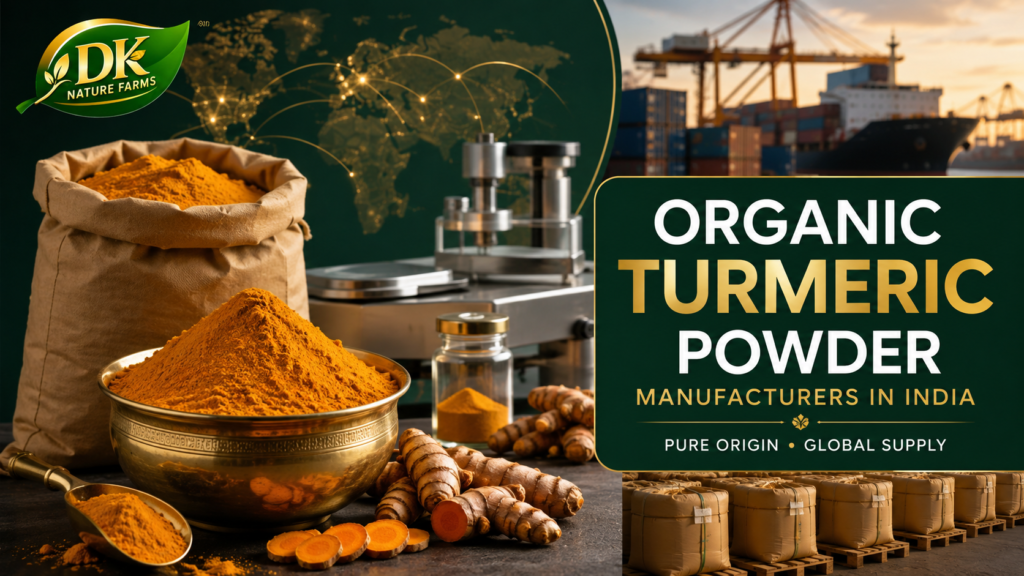
Organic Turmeric Powder Manufacturers India : 2026 Buyer Guide
Reliable organic turmeric powder manufacturers in India should disclose where the haldi is grown, how it is dried and ground, whether the organic claim is certified, and which batch tests are available. Buyers should compare moisture, curcumin content, pesticide residues, heavy metals, microbiology, packaging, MOQ and traceability. DK Nature Farms grows and stone-grinds small batches of haldi in Himachal Pradesh.
- Turmeric normally stays in the ground for about eight to nine months before harvest.
- DK Nature Farms harvests haldi mainly from October to January and packs it in small batches.
- “Organic” describes a controlled production system. It doesn’t guarantee a fixed curcumin percentage.
- Bulk organic-positioned turmeric powder may range roughly from ₹280 to ₹650 per kg in 2026, depending on certification, testing and order size.
- A batch-linked Certificate of Analysis is more useful than a generic purity claim.
Why Is Choosing an Organic Haldi Manufacturer So Difficult?
Bright yellow isn’t proof of purity. Yet buyers still judge turmeric by colour first, price second, and paperwork much later.
If you’re comparing organic turmeric powder manufacturers in India, your real problem isn’t finding a seller. India has thousands. The hard part is knowing who grows the crop, who processes it, who only trades it, and whether the powder delivered next month will match the sample you approved today.
A home buyer wants clean haldi with an honest farm story. A shop needs reliable packs and margins. A food brand may require organic certification, pesticide testing and a consistent grind. Export buyers have another list entirely. So how do you compare them fairly?
This guide gives you a practical 2026 checklist. You’ll learn what “organic turmeric powder” actually means, how haldi moves from soil to packet, how to spot warning signs, what documents to request, what prices may look like and when a small farm producer is a better fit than a high-volume factory.
What Exactly Is Organic Turmeric Powder?
Organic turmeric powder is dried and ground Curcuma longa produced under defined organic farming and handling requirements. A valid certified claim depends on the applicable standard, operator and certification scope. It isn’t simply a packet with “natural” printed in green.
The whole rhizome naturally contains curcuminoids, volatile oils, fibre, starch and other plant compounds. Curcumin is part of turmeric, not the entire powder. That is why ordinary organic haldi powder and a 95% curcuminoid extract are not interchangeable.
Organic practice, certified status and residue test results aren’t identical. For formal organic exports, review programme and certification information from APEDA. Ask which claim applies to the offered batch.
| Term on the offer | What it usually means | What you should verify |
|---|---|---|
| Natural turmeric | A broad marketing description | Ingredients, farm inputs and tests |
| Pesticide-free claim | No pesticide use claimed or residues not detected to a stated limit | Farm record and recent residue report |
| Organic-grown | Produced using stated organic practices | Method, traceability and claim wording |
| Certified organic | Covered by a recognised certification system | Certificate validity, crop and operator scope |
| Organic turmeric extract | Processed, concentrated turmeric ingredient | Organic processing scope, assay and solvents |
Which Type of Organic Turmeric Powder Manufacturer Fits Your Order?
The right manufacturer depends on your required volume, grind, certification, packing and level of farm traceability. A family farm and a 20-tonne factory solve different problems.
A grower-processor suits you if you value a short supply chain and direct field knowledge. A contract manufacturer fits printed pouches, blending and thousands of identical units. A trader may combine origins, while an exporter manages shipment documents.
DK Nature Farms is a family-run farm producer in Himachal Pradesh. We grow haldi beneath the mango orchard planted by our grandfather, feed the soil with cow dung manure, weed by hand, sun dry the crop, stone grind it and pack small batches. You can read the farm and family story before sending a requirement.
State your volume clearly. An honest supplier should tell you where their capacity ends.
How Is Farm-Grown Organic Haldi Powder Made?
Farm-grown organic haldi powder is made by cultivating mature rhizomes, harvesting them carefully, cleaning, drying, grinding and packing under controlled conditions. Every stage affects the aroma, moisture and shelf stability you finally receive.
- Planting: Healthy turmeric rhizomes go into prepared soil and remain there for about eight to nine months.
- Field care: Our team uses cow dung manure and removes weeds by hand. No pesticide or chemical fertiliser is used on the crop.
- Harvest: Mature rhizomes are usually lifted between October and January at our Himachal farm.
- Cleaning and drying: Soil is removed, then the haldi is sun dried carefully. Moisture needs to fall without exposing the crop to dirty surfaces.
- Grinding: Stone grinding produces the whole-food powder we sell. The grind size should suit the intended use.
- Packing: Small batches go into clean, sealed packs that protect the powder from humidity, light and foreign odours.
One real farm observation: shade differs across our mango orchard, and haldi colour shifts slightly between harvest lots. Rain, soil moisture and maturity affect a living crop. Unexplained variation still deserves questions.
You can see our organic haldi powder and whole turmeric root alongside moringa, red chilli powder and Haldi Piperine capsules.
How Can You Spot Pure Versus Adulterated Turmeric Powder?
You can assess turmeric purity through traceability, sensory checks and proper laboratory testing, but colour alone cannot prove purity. Very bright powder can be genuine, or it can hide an unwanted colourant.
- Read the ingredient line: It should identify turmeric powder and disclose any added ingredient.
- Smell it: Fresh whole-food haldi has a warm, earthy aroma. A flat smell may indicate age or poor storage.
- Check the texture: Agree on grind size. Excess grit, visible foreign particles or uneven lumps need explanation.
- Trace the batch: The pack, invoice, sample and COA should connect to one batch number.
- Test what matters: Depending on use, check moisture, curcuminoids, microbes, heavy metals, pesticide residues, aflatoxins and prohibited colours.
- Inspect the pack: A clean food-grade liner and proper seal protect good powder after it leaves the mill.
FSSAI publishes food safety and adulteration guidance, including consumer awareness material. Home checks can flag obvious problems, but can your kitchen glass identify a pesticide residue measured in parts per million? No. Commercial buyers need suitable laboratory evidence.
Which Quality Documents Should a Buyer Request?
Buyers should request a written specification, batch-specific Certificate of Analysis, food business details and proof supporting every major claim. Export and certified-organic orders need additional documents.
| Document or test | What it confirms | When to request it |
|---|---|---|
| Product specification | Agreed moisture, mesh, sensory and safety limits | Before approving the quote |
| Batch COA | Results linked to one production lot | Before dispatch of each lot |
| Food business licence | Identity of the licensed Indian operator | Supplier onboarding |
| Organic certificate | Operator, product and certification scope | Before using a certified claim |
| Pesticide residue report | Tested residues and reporting limits | Organic, retail brand and export orders |
| Microbiology and contaminants | Microbial counts, metals or aflatoxins as specified | Food production and bulk buying |
For spice quality and export information, refer to the Spices Board India. Certificates expire, so check the operator, dates and scope.
What Is the Organic Turmeric Powder Price in India in 2026?
Organic turmeric powder prices in India commonly vary from roughly ₹280 to ₹650 per kg in bulk, while retail and specialised small-batch products may cost more. These are broad market indications, not a fixed DK Nature Farms quotation.
| Supply format | Indicative 2026 range | Main price factors |
|---|---|---|
| Conventional bulk turmeric powder | About ₹180 to ₹320/kg | Origin, grade, season and quantity |
| Organic-positioned bulk powder | About ₹280 to ₹650/kg | Farm practice, certification, testing and lot size |
| Small-batch farm powder | Quoted by pack and quantity | Direct processing, packaging and freight |
| Private-label retail packs | Quote per unit | Pouch, printing, filling, MOQ and testing |
| Export-ready consignment | Quote required | Documents, destination tests, packing and logistics |
Compare ex-works price, GST, freight, packing and testing separately. A cheap mill-gate quote may exclude them all.
Tell us the pack size, quantity and destination. We reply the same day.
Is Organic Turmeric Better Than Regular Turmeric?
Organic turmeric offers documented controls over cultivation and handling, while regular turmeric may use permitted conventional inputs. Better for you still depends on purity, freshness, testing and how you plan to use it.
| Factor | Organic turmeric powder | Regular turmeric powder |
|---|---|---|
| Farm inputs | Restricted by the relevant organic standard | Permitted conventional inputs may be used |
| Certification | Required for a formal certified-organic claim | No organic certificate expected |
| Curcumin level | Varies with variety and crop conditions | Also varies with variety and crop conditions |
| Traceability | Usually documented for certified supply | Ranges from farm-traceable to commodity mixed lots |
| Price | Often higher due to farming, audit and segregation costs | Generally lower at commodity volume |
Brand recognition doesn’t replace reading the label, batch and certification details.
What Mistakes Do Buyers Make While Choosing a Manufacturer?
Buyers usually make mistakes by chasing the lowest price before defining grade, claim, quantity and testing. The result is a quotation table that compares unlike products.
- Treating “natural” as certified organic: Ask which standard and certificate support the exact claim.
- Approving only by colour: Natural crop colour shifts. Test identity and unwanted colours properly.
- Accepting a generic COA: Your delivered bag should match the batch named in the document.
- Ignoring moisture and storage: Even good haldi can deteriorate inside a damp warehouse.
- Skipping a trial lot: Check aroma, taste, flow and recipe behaviour before you buy 500 kg.
- Forgetting landed cost: Include GST, testing, packing, transport and any private-label setup.
How Do You Choose Among Organic Turmeric Powder Manufacturers in India?
Choose among organic turmeric powder manufacturers in India by matching their real capability to your specification, volume and traceability needs. Ask direct questions and expect direct answers.
- Write your required quantity, pack size, grind, use and destination.
- Ask whether the supplier grows, processes, packs or trades the powder.
- Request current certification, specification and a sample batch COA.
- Test a representative sample against your own acceptance limits.
- Confirm lead time, batch size, freight, payment and complaint handling in writing.
- Place a manageable first order before planning repeat supply.
India has well-known turmeric origins, including Lakadong in Meghalaya and major southern growing belts. Himachal Pradesh is smaller and less industrial, which can suit buyers who want a closer farm connection. The origin story matters. The delivered product still has to pass your checks.
To discuss whole haldi, stone-ground powder or retail packs, send us an enquiry. For more honest notes about crops, sourcing and food, visit the DK Nature Farms Journal.
Share the quantity, packing and delivery PIN code. We reply the same day.
Frequently Asked Questions
Who are reliable organic turmeric powder manufacturers in India?
Reliable manufacturers disclose their role in growing or processing, share supporting certification where applicable, and provide batch-linked quality documents. DK Nature Farms grows and stone-grinds small lots of haldi in Himachal Pradesh. Buyers needing very large industrial volumes should also verify processing capacity, third-party testing, packing options and repeat supply.
What is the wholesale price of organic turmeric powder in India?
Bulk organic-positioned turmeric powder may broadly range from about ₹280 to ₹650 per kg in 2026. The actual price depends on crop origin, certification, curcumin level, testing, mesh, quantity, packaging and freight. Request a written quote with GST and transport shown separately before comparing suppliers.
How can I verify that turmeric powder is genuinely organic?
Ask for the organic certificate and check the operator, validity, product scope and certification programme. Then connect the supplied batch to invoices and traceability records. Organic certification and a pesticide residue report answer different questions, so commercial buyers may request both according to their own specification and destination market.
Is organic haldi powder the same as curcumin powder?
No. Organic haldi powder is the whole dried turmeric rhizome in ground form. It naturally contains curcumin along with oils, fibre, starch and other compounds. “Curcumin powder” often refers to a concentrated extract with a stated curcuminoid percentage. Compare the product specification, not just the yellow appearance.
Can DK Nature Farms supply organic turmeric powder in bulk?
DK Nature Farms accepts bulk and retail enquiries subject to harvest stock, required quantity, pack size and documentation. The haldi is grown under mango trees in Himachal Pradesh, sun dried and stone ground in small batches. Share your delivery PIN code and intended use for an accurate availability and price response.
What tests should bulk turmeric powder pass?
A buyer may specify identity, moisture, mesh, curcuminoid content, microbiological limits, heavy metals, pesticide residues, aflatoxins and prohibited colours. Not every order uses the same panel. Write your acceptance limits before purchase and ensure the report names the tested batch, method and reporting laboratory.
Can Indian organic turmeric powder be exported?
Yes, Indian turmeric is exported widely, but each destination has its own import, residue, microbiological, labelling and documentation requirements. Confirm organic equivalence, certificates, testing, shelf life, tariff classification and packing before dispatch. APEDA and Spices Board India provide official starting information for exporters and buyers.
How should organic turmeric powder be stored?
Store turmeric powder in an airtight, food-safe container away from direct sun, heat, moisture and strong odours. Use a clean, dry spoon and close the lid quickly. Commercial buyers should keep bags off the floor in a dry warehouse, follow stock rotation and retain each batch label for traceability.
What Should You Remember Before Ordering?
Define the grade, verify the claim and test the delivered batch before you commit to repeat supply. Those three steps remove most avoidable risk.
Organic doesn’t mean every farm lot has the same curcumin level. A bright colour isn’t a purity certificate. And a cheap mill-gate price isn’t your final landed cost.
The right partner should explain origin, processing, documents and volume. If you value stone grinding and a Himachal farm, speak with DK Nature Farms. Send your quantity, pack size, destination and testing requirements.