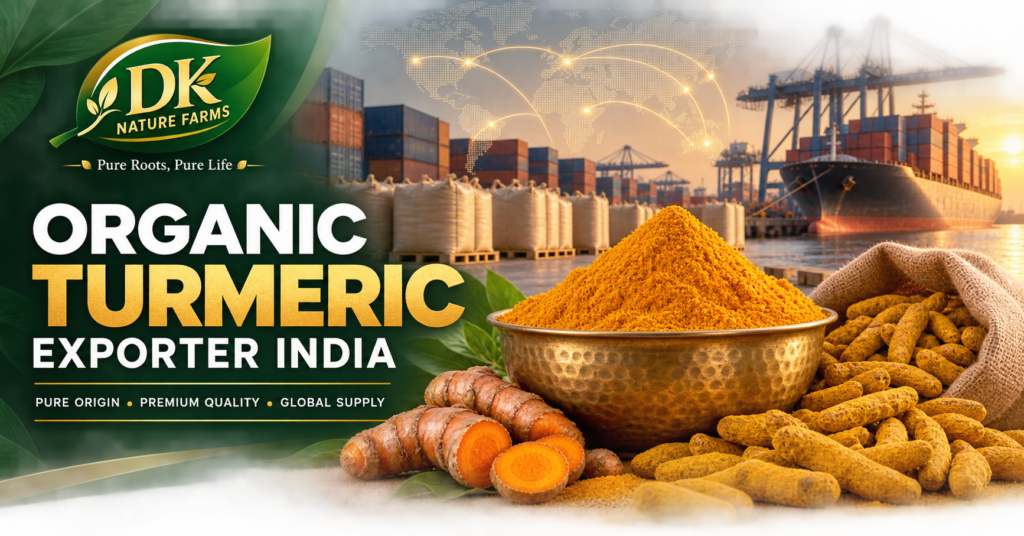
Organic Turmeric Exporter India: Farm-Grown Haldi for Bulk Supply in 2026
If you’re looking for an organic turmeric exporter in India, focus on traceability,
farming practices, processing, consistency and export documentation rather than price
alone. DK Nature Farms grows turmeric in Himachal Pradesh using cow dung manure,
without chemical fertilisers or pesticides. Our haldi is hand harvested, sun dried
and available as whole turmeric root and stone-ground powder for suitable bulk enquiries.
- India is one of the world’s most important turmeric-producing and exporting countries.
- DK Nature Farms grows turmeric in Himachal Pradesh under the shade of a family mango orchard.
- We use cow dung manure and don’t use chemical fertilisers or pesticides on the crop.
- Turmeric is available as whole dried root and stone-ground powder.
- Bulk and export buyers should check traceability, processing, documentation and batch quality before choosing a supplier.
who can clearly tell you where the turmeric came from, how it was grown, how it was dried
and what happened before it reached the bag is a different matter.
That’s where buyers need to ask better questions.
At DK Nature Farms, our turmeric doesn’t begin in
a warehouse or wholesale mandi. It begins on our family farm in Himachal Pradesh. The crop
grows under mango trees, receives cow dung manure, is hand weeded and is harvested during
our seasonal cycle, generally between October and January.
This guide explains what importers, distributors, food businesses and bulk buyers should
look for when sourcing Indian turmeric in 2026, including quality, processing, adulteration
risks, pricing and the difference between regular and organically grown turmeric.
What Exactly Is Organic Turmeric?
Organic turmeric is turmeric grown without routine use of synthetic chemical
fertilisers and pesticides and handled according to applicable organic production standards.
For export buyers, the word “organic” shouldn’t simply be accepted because it appears on a
packet or quotation.
Ask how the crop was grown. Ask about certification where certified organic status is
required. Ask how different batches are handled. And if you’re importing commercially,
check which certification and documentation your destination country requires.
India’s organic agricultural exports and certification ecosystem is overseen through
systems connected with
APEDA.
Food businesses should also understand applicable requirements from
FSSAI.
Why Do International Buyers Source Turmeric From India?
India offers buyers a large turmeric-growing base, established spice processing
infrastructure and access to multiple turmeric varieties and supply regions.
Different regions have different reputations. Lakadong in Meghalaya, for example, is
well known for turmeric associated with higher curcumin levels. Other important spice
regions include parts of Telangana, Maharashtra, Tamil Nadu and Andhra Pradesh.
But geography alone doesn’t guarantee quality.
A serious buyer should look at the actual batch. Moisture, aroma, colour, cleanliness,
processing and storage matter. Export specifications can also differ substantially between
a food manufacturer buying powder and a spice company importing whole fingers for its own
processing.
For official information about Indian spice exports and standards, buyers can refer to
Spices Board India.
How Is Turmeric Grown at DK Nature Farms?
Our turmeric is grown on our family farm in Himachal Pradesh using cow dung manure,
hand weeding and no chemical fertiliser or pesticide application on the crop.
There is something you’ll notice when you actually grow food instead of buying finished
powder from a market. Every harvest isn’t visually identical.
The shade, weather and growing conditions shift a little. So can the natural colour of
the rhizomes.
Our haldi grows under the mango orchard planted by our grandfather, late Sh. Dharam Singh
Chambial. He didn’t want chemicals sprayed around those trees. That approach stayed with
the family.
After harvest, the turmeric is cleaned and dried before further processing. For powder,
we use stone grinding and pack in smaller batches on the farm.
You can read more about
our farm and family story
or see our
farm products.
Should You Import Whole Turmeric or Turmeric Powder?
Whole turmeric is usually better for buyers who want greater control over final
grinding, while turmeric powder is more convenient for businesses that need a ready-to-use product.
| Factor | Whole Turmeric | Turmeric Powder |
|---|---|---|
| Processing | Buyer can grind after import | Already ground |
| Visual inspection | Easier to inspect whole rhizomes | Requires stronger batch testing |
| Convenience | Requires processing | Ready for packing or use |
| Best suited for | Processors and spice businesses | Retailers and food businesses |
| Storage considerations | Needs dry, suitable storage | Moisture-proof packaging is important |
At DK Nature Farms, you can enquire about both
organic haldi whole root and stone-ground turmeric powder.
How Can You Spot Pure Turmeric Before Buying in Bulk?
Bulk buyers should check turmeric through documentation, physical inspection,
supplier traceability and appropriate laboratory testing rather than judging colour alone.
- Check the aroma. Turmeric should have a recognisable earthy,
warm smell. An unusually weak aroma deserves further inspection. - Don’t chase unnaturally bright colour. Natural agricultural
products can vary between harvests. - Ask where it was grown. A supplier should be able to explain the
origin of the batch. - Check moisture and storage. Poorly dried turmeric can create
storage and quality problems later. - Request relevant testing. Importers should define the testing
required for their market and intended use before placing a commercial order.
FSSAI also publishes consumer information related to food adulteration and testing through
its
food safety resources.
Organic Turmeric vs Regular Turmeric: What’s the Difference?
The main difference is the farming and certification framework, not simply the
colour of the finished turmeric.
| Point | Organically Grown Turmeric | Conventional Turmeric |
|---|---|---|
| Fertilisation | Organic inputs under the relevant farming system | May use synthetic fertilisers |
| Pest management | Organic-compliant methods | Conventional pesticides may be used |
| Certification | Required when sold under applicable certified organic claims | Organic certification isn’t applicable |
| Traceability | Important for certification and export | Varies by supplier |
| Price | Can carry a premium | Often lower |
Don’t assume expensive turmeric is automatically better. And don’t assume cheap turmeric
is automatically adulterated either. What matters is whether the supplier can support the
claims being made about that batch.
What Determines Organic Turmeric Export Prices From India?
Organic turmeric export prices depend on crop quality, form, certification,
testing, quantity, packaging, processing and freight requirements.
This is why giving one universal ₹ per kg export price can be misleading.
| Factor | How It Can Affect Price |
|---|---|
| Whole root vs powder | Powder requires additional processing |
| Order quantity | Larger orders can change unit economics |
| Certification | Certified supply may involve additional compliance costs |
| Lab testing | Buyer-specific testing adds cost |
| Packaging | Retail and bulk packaging have different costs |
| Freight | Destination, shipment size and transport mode matter |
So instead of asking only, “What’s your turmeric price?”, send the quantity, required
form, destination country, packaging requirement and certification requirement.
You’ll get a much more useful quotation.
Tell us the product, quantity and destination. We reply the same day.
How Should You Choose an Organic Turmeric Exporter in India?
Choose a turmeric supplier who can explain the product’s origin, processing,
quality controls and documentation clearly before asking you to place a large order.
Here are six practical questions worth asking:
- Where exactly is your turmeric grown?
- Do you supply whole turmeric, powder or both?
- How is the turmeric dried and processed?
- What certifications and documents are available?
- Can you accommodate buyer-specific testing?
- What packaging and bulk quantities can you supply?
And ask for samples where commercially practical.
A beautiful website doesn’t tell you what is inside a turmeric bag. Traceability does.
Documentation does. The actual batch does.
If you’d like to discuss sourcing directly, you can
send us an enquiry.
What Mistakes Do Buyers Make When Sourcing Turmeric From India?
The most common sourcing mistake is comparing suppliers only by their quoted
price per kilogram.
- Comparing unlike specifications: One quote may include testing and better packaging while another doesn’t.
- Judging by colour alone: Brighter doesn’t automatically mean better.
- Ignoring moisture: Storage stability matters for long-distance shipments.
- Not defining powder specifications: Grinding and particle size requirements should be discussed beforehand.
- Assuming “organic” means certified: Ask what certification supports the claim if certification is required.
- Ordering before checking documentation: Import requirements vary between countries.
If you’re researching other naturally grown farm products too, browse the
DK Nature Farms Journal.
Share your quantity, product format and destination with our family team.
Frequently Asked Questions About Organic Turmeric Export From India
1. Who is an organic turmeric exporter in India?
An organic turmeric exporter supplies Indian turmeric to buyers outside India while meeting
the applicable quality, documentation and certification requirements. DK Nature Farms in
Himachal Pradesh grows and supplies turmeric and accepts suitable bulk enquiries for whole
turmeric root and stone-ground turmeric powder.
2. Can I buy organic turmeric directly from a farm in India?
Yes. Some Indian farms sell turmeric directly rather than sourcing finished products through
multiple traders. Buying from a farm can make origin and farming practices easier to understand.
You should still verify specifications, certification requirements, testing and export
documentation for your destination.
3. Does DK Nature Farms supply whole turmeric?
Yes. DK Nature Farms produces whole turmeric root as well as stone-ground turmeric powder.
For bulk requirements, tell us which format you need, the approximate quantity, destination
and packaging preference so the enquiry can be assessed properly.
4. Where is DK Nature Farms turmeric grown?
Our turmeric is grown on the family farm in Himachal Pradesh, India. It grows beneath a
mango orchard and receives cow dung manure. The crop is hand weeded, harvested seasonally
and processed in small batches rather than being purchased as anonymous finished powder.
5. What should importers check before ordering turmeric from India?
Importers should check product origin, moisture, processing method, packaging, applicable
certifications, laboratory requirements and export documentation. Your country’s import
rules matter too. Agreeing on specifications before confirming a commercial shipment helps
avoid misunderstandings later.
6. Is whole turmeric better than turmeric powder for import?
Neither format is automatically better. Whole turmeric gives processors more control over
final grinding and makes visual inspection easier. Powder saves processing time and may suit
retailers or food manufacturers better. Your intended use should determine which format
makes more sense.
7. How can I get a bulk turmeric quotation?
Send DK Nature Farms your required quantity, whole root or powder preference, destination,
packaging requirement and any specific certification or testing requirements. You can
order from the farm or send an export enquiry
directly.
Buying Indian Turmeric Starts With Knowing Its Source
If you’re searching for an organic turmeric exporter in India, keep three
things in mind. Know where the turmeric was grown. Understand how it was processed. And
agree on specifications and documentation before discussing a large shipment.
At DK Nature Farms, our turmeric begins on our family land in Himachal Pradesh, under the
mango trees our grandfather planted. We use cow dung manure, hand weed the crop, sun dry
the harvest and stone grind our turmeric powder in small batches.
If that is the kind of traceability you’re looking for, tell us what you need. Send your
quantity, destination and preferred turmeric format through our
farm enquiry page.