
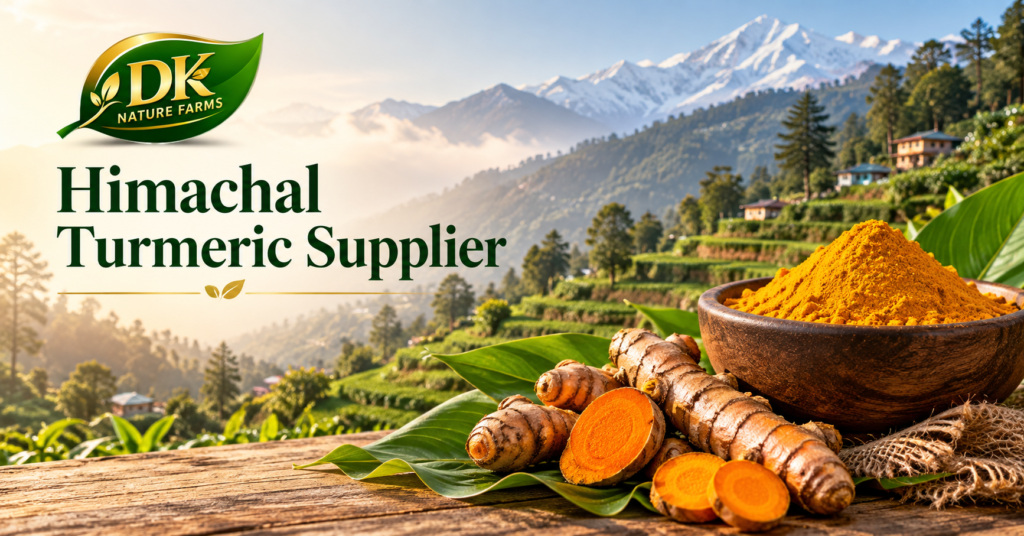
Himachal Turmeric Supplier: Farm-Direct Haldi for Your Kitchen in 2026
DK Nature Farms is a family-run Himachal turmeric supplier offering whole dried haldi and stone-ground turmeric powder. Our crop grows beneath the family mango orchard, with cow dung manure, hand weeding and no pesticide spraying. For home or bulk orders, ask about the available harvest, pack size, delivered price and supporting quality documents. Confirm certification separately if certified organic supply is essential to your purchase.
- Our haldi spends about nine months in the ground before harvest.
- The farm’s harvest window runs from October to January.
- Powder pack sizes are 100 g, 250 g, 500 g and 1 kg.
- Whole dried fingers come in 250 g, 500 g and 1 kg packs.
- Home orders and bulk enquiries go directly to the family at +91 78071 49747.
What can a bright yellow packet actually tell you about the farm behind it? Very little, unless someone is willing to answer your questions.
If you’re looking for a Himachal turmeric supplier, you probably want more than a pleasant colour in your dal. You want to know where the haldi grew, what went into the soil, who ground it and whether the next packet will come from the same place. Those are sensible questions. They deserve clear answers.
At DK Nature Farms, turmeric is tied to our family land in Himachal Pradesh. It grows under mango trees planted by our grandfather, and we handle the crop ourselves. That makes the conversation personal. You can ask us about the harvest instead of guessing from a label.
This guide explains how to compare whole roots and powder, what to check before buying, and how to request a useful quotation. We’ll also separate farming practices from certification, because you shouldn’t have to work out what a seller means by “organic” after you’ve already paid.
What should a Himachal turmeric supplier tell you?
A Himachal turmeric supplier should explain the crop’s origin, processing, available quantity and price before you place an order.
A Himachal address alone doesn’t establish where the turmeric was grown. Ask whether the business grows its own crop, buys from identified farmers or sources through traders. Each arrangement can serve a purpose. What matters is whether the explanation matches the product you’re buying.
Farm-direct turmeric means you buy through the grower rather than an unrelated reseller. At DK Nature Farms, that conversation starts with our own harvest. If you need more than the farm can supply, availability needs an honest discussion.
For a shop in Solan, a kitchen in Baddi or a buyer in Paonta Sahib, the practical questions remain similar: which batch, which format, how much stock and what delivery arrangement? Start there.
How do we grow and prepare haldi on our family farm?
We grow haldi beneath our mango orchard using cow dung manure, hand weeding and no chemical fertiliser or pesticides, then sun-dry, stone-grind and pack it on the farm.
The name carries two people with it. D remembers the late Sh. Dharam Singh Chambial, our grandfather, who planted the mango orchard and refused to spray it. K honours Kamla Devi Chambial, our grandmother, whose rule was simple: nothing should leave the farm that the family wouldn’t eat themselves.
Deepak handles farm operations, Harsh looks after brand and marketing, and Vivek manages orders and supply alongside our elders. You can read the farm and family story before deciding whether our way of working suits you.
Here’s one small observation from our batches: the powder’s shade shifts a little between harvests. We don’t add colour to make every pouch match. That variation isn’t a purity certificate, but it explains why we don’t promise an identical yellow every time.
The crop takes about nine months. The October–January harvest window also means seasonal planning matters if you need a recurring quantity.
Should you buy whole turmeric roots or ready-ground powder?
Choose whole dried turmeric if you want to grind it yourself, or powder if you need haldi ready for everyday cooking.
Turmeric is the rhizome, or underground stem, of Curcuma longa, as described by Spices Board India. Buyers often call the dried pieces roots or fingers. Check the form carefully, because dried fingers and fresh raw haldi aren’t interchangeable in every recipe.
| Buying point | Whole dried fingers | Turmeric powder |
|---|---|---|
| Preparation | Needs suitable grinding equipment | Ready to measure into food |
| Listed packs | 250 g, 500 g, 1 kg | 100 g, 250 g, 500 g, 1 kg |
| What you can inspect | The individual dried pieces | The powder’s texture and aroma |
| Best fit | Buyers who prefer grinding small quantities | Busy home kitchens and regular cooking |
| Important limitation | Appearance doesn’t prove purity | Colour doesn’t prove purity either |
You can compare whole haldi and stone-ground turmeric powder on our products page. If you’re trying the farm for the first time, choose a quantity you can use comfortably before planning a larger order.
How is organic turmeric different from regular turmeric?
Organic turmeric is distinguished by its production system and, where claimed, verifiable certification rather than by colour or packaging alone.
Certified organic turmeric has supporting certification under an applicable organic standard. APEDA’s National Programme for Organic Production describes a certification framework involving production standards and accredited certification bodies.
We describe our actual practices: cow dung manure, hand weeding and no pesticide spraying. If your purchase requires certified organic stock, ask for the current documents and their scope. This article doesn’t establish that DK Nature Farms holds certification.
| Point | Certified organic turmeric | Regular turmeric |
|---|---|---|
| Production claim | Assessed against an organic standard | Doesn’t carry that certification claim |
| What to request | Valid certificate covering the relevant product and operator | Origin, processing and batch information |
| Colour | Can vary | Can also vary |
| Purity evidence | Certification doesn’t replace a relevant batch test | Ask for relevant testing when needed |
| Buying decision | Useful where verified organic sourcing is required | Assess the supplier and product on available evidence |
Neither a mountain photograph nor the word “natural” answers these questions for you.
How can you check turmeric quality before buying?
You can reduce uncertainty by checking the supplier’s identity, ingredient statement, batch information and relevant testing instead of relying on a colour test.
Would you judge the whole harvest by how quickly a spoonful turns water yellow? It’s tempting, but a kitchen observation can’t establish everything you need to know.
- Ask for origin. Get a clear answer about whether the turmeric was grown on the named farm.
- Read the ingredient statement. Understand whether you’re buying plain turmeric or a blend.
- Check the packet. Look for the batch, packing information, best-before guidance and a usable seller contact.
- Request evidence for specific claims. A curcumin percentage needs an appropriate report, not just confident wording.
- Agree quality requirements before a bulk purchase. Tell the supplier which tests or documents your business needs.
FSSAI’s home adulteration resources introduce screening checks through DART. Treat screening as a starting point, not proof that a batch is free from every contaminant. Avoid improvised chemical experiments at home.
How do you compare Himachal turmeric supplier prices in 2026?
Compare the delivered price for the same turmeric format and quantity, including shipping and any other quoted charges.
Our website takes enquiries rather than publishing a fixed price list. So we won’t insert an unverified ₹ range here. Ask for today’s written quotation, especially when you’re comparing retail packs with bulk supply.
| Product | Quantity options | Price basis to request |
|---|---|---|
| Haldi powder | 100 g, 250 g, 500 g, 1 kg | Current ₹ per pack and delivered total |
| Whole dried haldi | 250 g, 500 g, 1 kg | Current ₹ per pack and delivered total |
| Bulk order | State your required kilograms | ₹ per kg, availability and freight |
For comparison, divide the total amount payable by the kilograms you’re receiving. A low pack price can look different once delivery is added. Ask whether the quotation includes applicable taxes, and confirm dispatch timing before payment.
To send us an enquiry, share the product, quantity, delivery PIN code and preferred date. For recurring supply, mention your monthly requirement. Export buyers should state the destination and documentation needs before discussing an order.
How can you use and store farm-grown haldi?
Use haldi in familiar dishes and keep the remaining stock sealed, dry and away from heat and direct sunlight.
Start with your usual recipe. For a small pot of dal, you might try a quarter teaspoon and adjust the next time to your taste. That is a cooking suggestion, not a health dose. You can also add a little to sabzi, khichdi or a paneer marinade.
More isn’t always better. Too much can overwhelm a gentle dish, especially when you’re still getting used to a new batch.
Keep a dry spoon in your routine, not a damp one from the cooking pot. Close the container promptly. If you buy a larger pack, keep only a small working quantity near the stove and store the rest away from steam. Follow the packet’s best-before and storage instructions rather than assuming every spice lasts indefinitely.
Which turmeric buying mistakes should you avoid?
Avoid choosing turmeric by colour, headline price or unsupported claims without checking the details behind them.
- Assuming the brightest yellow is best. Colour is one observation, not a complete quality assessment.
- Confusing dried and fresh roots. If you want raw haldi for a pickle, confirm availability instead of ordering dried fingers.
- Buying a large quantity before trying it. A small first order helps you judge how the product works in your cooking.
- Ignoring shipping. Compare the final delivered amount, especially across differently sized packs.
- Accepting a high-curcumin claim without evidence. Ask which batch was tested and whether the report applies to your order.
And don’t assume a region name guarantees a particular composition. If you compare Himachal turmeric with a Lakadong-labelled product, ask both sellers for evidence supporting their specific claims. The same questions protect your purchase wherever the crop grows.
Frequently asked questions about buying Himachal turmeric
Before ordering Himachal turmeric, confirm the available format, harvest, price, delivery and any certification your purchase requires.
Can I buy turmeric directly from DK Nature Farms?
Yes, you can enquire directly with DK Nature Farms about whole dried haldi or stone-ground powder. Share your preferred product, quantity and delivery PIN code by WhatsApp or phone at +91 78071 49747. The family can confirm available stock, the quotation and dispatch details before you place your order.
Does DK Nature Farms offer bulk turmeric supply?
DK Nature Farms accepts bulk turmeric enquiries, subject to the farm’s available harvest. Tell us the total kilograms you need, your location and whether the requirement repeats monthly. Ask about sample availability and agree any documentation or testing requirements before committing to a larger purchase.
Is the farm’s turmeric certified organic?
The farm describes using cow dung manure, hand weeding and no chemical fertiliser or pesticides. Those practices don’t, by themselves, establish certified organic status. If certification is essential for your purchase, request current supporting documents and confirm they cover the relevant product and supplier before ordering.
When is turmeric harvested at the farm?
DK Nature Farms lists October to January as its turmeric harvest season, with the crop spending about nine months in the ground. Harvest timing isn’t the same as immediate dispatch availability. Ask which batch is currently ready, whether processing is complete and when your chosen quantity can be packed.
What is the price of one kilogram of turmeric?
DK Nature Farms doesn’t publish a fixed one-kilogram turmeric price on its products page. Request the current ₹ quotation for powder or whole dried fingers, and include your delivery PIN code. Compare the full delivered amount, rather than assuming that a pack price includes shipping or other applicable charges.
Can colour prove that turmeric is pure?
No, colour alone cannot prove turmeric purity or establish its curcumin content. Natural batches can differ in shade, and appearance doesn’t replace suitable testing. Check origin, ingredients and batch details, then ask for relevant evidence if your purchase depends on a particular purity specification or composition claim.
Choose a supplier who answers the practical questions
The right supplier gives you a traceable origin, clear product information and a quotation you can understand.
Keep three things in mind. Know where your haldi grew. Choose whole dried fingers or powder according to how you’ll use it. And check the evidence behind any certification or composition claim that matters to you.
Our family can explain how we grow, dry and pack the turmeric from our Himachal land. You can start with a home-sized enquiry or discuss a larger requirement, with availability confirmed before you commit. There’s no need to rush into a quantity you haven’t thought through.
When you’re ready, order from the farm by sharing your preferred format, quantity and delivery location. We’ll take the conversation from there. Pure Roots. Pure Life.