APEDA Registered Turmeric Exporter India: Farm-Grown Haldi Supply in 2026
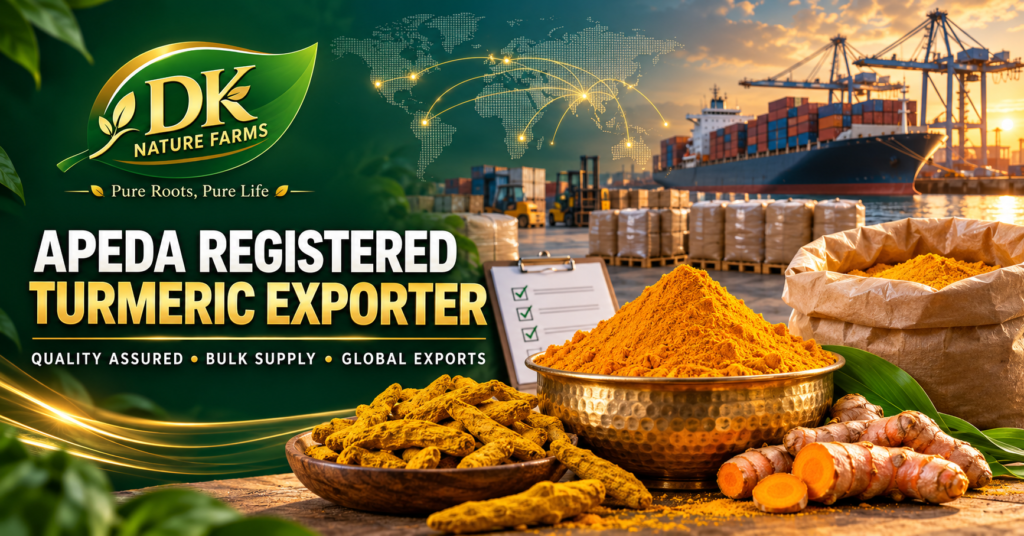
If you’re searching for an APEDA registered turmeric exporter in India, check the exporter’s current registration, product traceability, turmeric origin, processing, testing and shipment documentation before ordering. DK Nature Farms grows turmeric on its family farm in Himachal Pradesh using cow dung manure, without chemical fertilisers or pesticides, and supplies whole dried turmeric and stone-ground turmeric powder for suitable bulk and export enquiries.
- APEDA is a Government of India authority connected with the export promotion and development of scheduled agricultural and processed food products.
- Exporter registration alone doesn’t tell you the quality of the turmeric inside a shipment.
- DK Nature Farms grows turmeric on its family farm in Himachal Pradesh, India.
- Our main turmeric harvest generally runs from October to January.
- Bulk buyers can enquire for whole dried turmeric root and stone-ground turmeric powder.
Seeing the words “APEDA registered” on a supplier’s website can sound reassuring. But what does it actually tell you about the turmeric you’re buying?
Not everything.
If you’re searching for an APEDA registered turmeric exporter, registration should be one part of your supplier check. You still need to know where the turmeric was grown, how it was dried, who processed it, what specifications apply to your batch and which documents are available for the proposed shipment.
At DK Nature Farms, the story starts on our family farm in Himachal Pradesh. Our haldi grows beneath mango trees planted by our grandfather. We use cow dung manure, hand weed the crop and don’t use chemical fertilisers or pesticides on it. After harvest, the turmeric is dried, while turmeric intended for powder is stone ground and packed in smaller batches.
This guide explains what APEDA registration means, what it doesn’t mean, and what serious bulk and international buyers should check before choosing an Indian turmeric supplier in 2026.
What Is APEDA and What Does APEDA Registration Mean?
APEDA is India’s Agricultural and Processed Food Products Export Development Authority, a Government of India body associated with the development and promotion of exports of scheduled agricultural and processed food products.
For a buyer, the important point is simple. Don’t treat “APEDA registered” as a general quality award for a turmeric product.
Exporter registration and product quality are two different questions.
You can verify current information about registration, scheduled products, organic programmes and export-related requirements directly through the official APEDA website.
If a supplier claims a particular registration, certification or approval, ask for the relevant details and verify them where appropriate. Why rely on a logo alone when the underlying information can be checked?
Does APEDA Registration Guarantee Turmeric Quality?
APEDA registration by itself should not be treated as proof that a particular turmeric batch is pure, organic, high-curcumin or superior in quality.
This distinction matters.
A buyer still needs to define the actual product specification. For whole turmeric, that may include origin, moisture, cleanliness, physical appearance and other agreed parameters. For turmeric powder, grinding, particle size, moisture and buyer-specific testing may become relevant.
And if you’re buying a product marketed as certified organic, establish exactly which certification supports that claim and whether it is acceptable in your destination market.
| What You Check | What It Tells You |
|---|---|
| Exporter registration | Helps establish the exporter’s applicable registration status |
| Farm origin | Shows where the turmeric was grown |
| Organic certification | Supports an applicable certified organic claim |
| Laboratory testing | Checks agreed parameters for the tested batch |
| Processing details | Shows how the product was dried, ground or handled |
| Batch traceability | Helps connect the supplied product to its source and processing |
Why Do International Buyers Source Turmeric From India?
International buyers source turmeric from India because the country has a large turmeric-growing base, multiple producing regions and an established spice supply and export ecosystem.
But India doesn’t produce one single type of turmeric.
Lakadong in Meghalaya is widely associated with turmeric known for higher curcumin characteristics. Other turmeric-growing regions have their own varieties, farming conditions and commercial strengths.
For a buyer, origin is useful information, but it isn’t enough by itself. You need to inspect the actual specification of the turmeric you’re buying.
Official information on Indian spices, export activity and related requirements is available through Spices Board India.
How Is Turmeric Grown at DK Nature Farms?
DK Nature Farms grows turmeric on its family farm in Himachal Pradesh using cow dung manure, hand weeding and no chemical fertiliser or pesticide application on the crop.
Our haldi grows beneath a mango orchard planted by our grandfather, late Sh. Dharam Singh Chambial. He didn’t want chemicals sprayed around those trees. That thinking stayed with the family.
The crop stays in the field through its natural growing cycle, and our main harvest generally comes between October and January.
Here’s something you notice when you actually work around a farm. The colour doesn’t come out like a Pantone shade every season. Weather, soil and harvest conditions can cause natural variation.
After harvesting, the turmeric is cleaned and sun dried. Turmeric intended for powder is stone ground and packed in smaller batches on the farm.
You can read the DK Nature Farms family and farming story or explore our farm-grown turmeric and other products.
Should You Export Whole Turmeric or Turmeric Powder?
Whole turmeric is useful for buyers who want greater control over final processing, while turmeric powder suits buyers who need a ready-ground ingredient.
| Factor | Whole Turmeric | Turmeric Powder |
|---|---|---|
| Processing | Buyer can grind after purchase | Already ground |
| Visual inspection | Easier to inspect individual rhizomes | Greater reliance on specification and testing |
| Convenience | Requires further processing | Ready for suitable applications |
| Grinding control | Buyer controls final grinding | Grinding completed before supply |
| Typical buyer | Spice processors and mills | Food brands, packers and ingredient buyers |
DK Nature Farms can discuss bulk requirements for both whole turmeric root and stone-ground turmeric powder.
Which one should you choose? Start with your end use. A spice mill that wants to control grinding has different requirements from a brand looking for ready-ground powder.
How Can Buyers Check the Quality of Export Turmeric?
Buyers should check turmeric quality through traceability, agreed specifications, physical inspection and appropriate laboratory testing rather than relying on colour or marketing claims.
- Confirm the origin. Ask where the turmeric was actually cultivated.
- Check the processing method. Understand how it was cleaned, dried and ground.
- Review moisture requirements. Proper drying matters during storage and long-distance transport.
- Check cleanliness. Whole turmeric should be assessed for foreign material and other agreed physical parameters.
- Define powder specifications. If you’re buying powder, establish your grinding and particle requirements beforehand.
- Agree on testing. Specify laboratory parameters according to your intended use and destination market.
Food businesses can refer to FSSAI for official Indian food safety information and resources relating to food quality and adulteration.
Don’t judge turmeric purely by how bright yellow it looks. Natural colour can vary, and appearance alone doesn’t establish purity.
Organic Turmeric vs Conventional Turmeric: What’s the Difference?
Organic and conventional turmeric differ primarily in their production systems and, where certified organic claims are made, the certification requirements supporting those claims.
| Factor | Organic Production | Conventional Production |
|---|---|---|
| Farming inputs | Must follow applicable organic standards | Conventional approved inputs may be used |
| Synthetic fertilisers | Restricted under applicable organic systems | May be used |
| Pest management | Must follow applicable organic rules | Conventional pesticides may be used |
| Certification | Relevant for certified organic commercial claims | Organic certification doesn’t apply |
| Traceability | Important within certified supply chains | Depends on supplier and buyer requirements |
| Price | May carry additional production and certification costs | Depends on grade and market conditions |
At DK Nature Farms, we use cow dung manure and don’t use chemical fertilisers or pesticides on our turmeric crop. If your commercial order requires a specific organic certification, tell us exactly what you require during the enquiry stage.
What Affects the Price of Turmeric for Export?
Export turmeric pricing depends on product form, quantity, crop quality, testing, certification, packaging, freight and the commercial terms of the shipment.
This is why a simple “send turmeric price” message often isn’t enough for a meaningful export quotation.
| Pricing Factor | Why It Matters |
|---|---|
| Whole root or powder | Powder requires additional processing |
| Order quantity | Quantity changes packing and logistics economics |
| Testing | Buyer-specific laboratory testing adds cost |
| Certification | Required certification can affect supply and cost |
| Packaging | Bulk bags and retail-ready packs have different costs |
| Destination | Freight depends heavily on the shipment route |
| Shipment method | Air and sea freight have very different economics |
Send us your approximate quantity, destination country, whole root or powder requirement, packaging preference and any testing or certification requirement. Then the discussion becomes useful.
Tell us the product, quantity and destination. We reply the same day.
How Should You Choose an APEDA Registered Turmeric Exporter?
Choose an APEDA registered turmeric exporter by checking both the supplier’s applicable registration details and the actual product, traceability, testing and documentation behind the shipment.
Start with registration verification. Then go deeper.
- Ask for current registration details. Don’t rely only on a website badge or statement.
- Establish product origin. Know whether you’re dealing with farm-grown produce, aggregated produce or a finished product purchased from another processor.
- Define your specification. Whole root and powder require different discussions.
- Discuss laboratory testing. Agree on the parameters required for your destination and intended use.
- Confirm packaging. A 25 kg bulk requirement isn’t the same job as retail-ready packs.
- Discuss shipment documentation early. Don’t wait until the goods are packed.
If you’re evaluating DK Nature Farms for a bulk requirement, you can send us an enquiry with your specifications.
What Mistakes Do Bulk Turmeric Buyers Commonly Make?
The biggest mistake bulk turmeric buyers make is comparing suppliers only by price while ignoring specification, traceability, testing and documentation.
1. Treating APEDA registration as a product quality certificate.
Registration status and turmeric quality aren’t the same thing. Verify both separately.
2. Asking only for the cheapest ₹ per kg quote.
What does that price include? Packaging? Testing? Grinding? The same product format? Without comparable specifications, two quotations don’t tell you much.
3. Assuming every organic claim means the same thing.
If certified organic supply matters to your market, define the certification you require.
4. Choosing powder when whole turmeric suits the business better.
Processors may prefer whole root so they can inspect and grind it themselves.
5. Ignoring seasonality.
Our turmeric harvest generally runs from October to January. If you’re planning larger recurring quantities, discussing requirements before harvest can make more sense.
6. Waiting until dispatch to discuss documents.
Export requirements should be discussed before the commercial order is finalised.
For more practical information about turmeric and our other crops, you can browse the DK Nature Farms Journal.
What Information Should You Send With a Bulk Turmeric Enquiry?
A useful turmeric enquiry should include the required product, approximate quantity, destination, packaging preference and any specific testing or certification requirements.
You don’t need a 20-page purchasing document for an initial conversation. But “need haldi, send rate” leaves too many questions unanswered.
Send these details:
- Whole turmeric root or turmeric powder
- Approximate quantity in kg or metric tonnes
- Destination city and country
- Bulk or retail packaging requirement
- Required certification, if applicable
- Testing parameters required by your business
- Expected purchasing frequency
- Approximate delivery timeline
If you’re testing a new supplier, discuss sampling and commercial feasibility before jumping straight into a large order.
Share your quantity, destination and product requirements with our family team.
Frequently Asked Questions About APEDA Registered Turmeric Exporters
What is an APEDA registered turmeric exporter?
An APEDA registered turmeric exporter generally refers to an exporter holding applicable registration with India’s Agricultural and Processed Food Products Export Development Authority for relevant export activities. Buyers should verify current registration details and separately evaluate the turmeric’s origin, specification, processing, testing and documentation.
Does APEDA registration mean turmeric is organic?
No. APEDA registration and organic certification are different matters. If you require turmeric sold under a certified organic claim, ask which certification supports the product and whether that certification is suitable for your destination market and intended commercial use.
Does APEDA registration guarantee turmeric quality?
No single registration should replace product-level quality checks. Buyers should establish specifications and, where appropriate, use physical inspection, traceability information and laboratory testing to assess the particular batch they plan to purchase.
Can DK Nature Farms supply whole turmeric for bulk enquiries?
DK Nature Farms grows turmeric on its family farm in Himachal Pradesh and accepts suitable enquiries for whole dried turmeric root as well as stone-ground turmeric powder. Send your approximate quantity, destination, packaging and specific quality requirements for discussion.
Where does DK Nature Farms grow its turmeric?
Our turmeric grows on our family farm in Himachal Pradesh beneath a mango orchard planted by our grandfather. We use cow dung manure, hand weed the crop and don’t use chemical fertilisers or pesticides. Our main turmeric harvest generally runs from October through January.
What should international buyers check before ordering turmeric?
International buyers should check supplier details, product origin, agreed specifications, testing requirements, packaging, applicable certifications and shipment documentation. Import rules vary by destination, so buyers should also confirm the current requirements that apply in their own market.
How do I get a bulk turmeric quotation from DK Nature Farms?
Send the required product format, approximate quantity, destination, packaging preference and any specific testing or certification requirements. You can send DK Nature Farms a bulk turmeric enquiry or contact the farm team through WhatsApp at +91 78071 49747.
Registration Matters, but the Turmeric Still Matters More
Choosing an APEDA registered turmeric exporter shouldn’t stop at checking a registration number. You also need to understand where your turmeric came from, how it was grown and processed, and whether the actual batch matches your commercial requirements.
At DK Nature Farms, our turmeric begins on our family land in Himachal Pradesh. It grows beneath our mango orchard, receives cow dung manure, is hand weeded, harvested seasonally and sun dried. We offer whole dried turmeric and stone-ground powder for suitable bulk enquiries.
So start with three things: verify the supplier, define your product specification and agree on testing and documentation before the order moves ahead. If our farm-grown turmeric fits what you’re sourcing, send us your requirement directly.